

Author: Julius Probst, PhD
A longer version of this article was initially published on Recruitonomics.
After the post-pandemic boom, advanced economies are now in a synchronized economic downturn that is hitting young workers hardest. Central banks, reacting to the inflation surge in 2021 and 2022, hiked interest rates from near zero to above 4% in recent years. This has been weighing on growth and depressing the hiring outlook. Add in trade wars, geopolitical conflicts, and an industrial slowdown, and the result is a sharp cooling in labor demand.
Vacancies and job postings are at their lowest since the pandemic, leaving workers trapped in unfulfilling jobs and graduates bearing the brunt. Apart from the brief pandemic recession, university students now face the weakest jobs market in more than a decade, struggling to find entry-level positions. Welcome to the Global Graduate Recession!
The aggregate data hides underlying labor market weakness
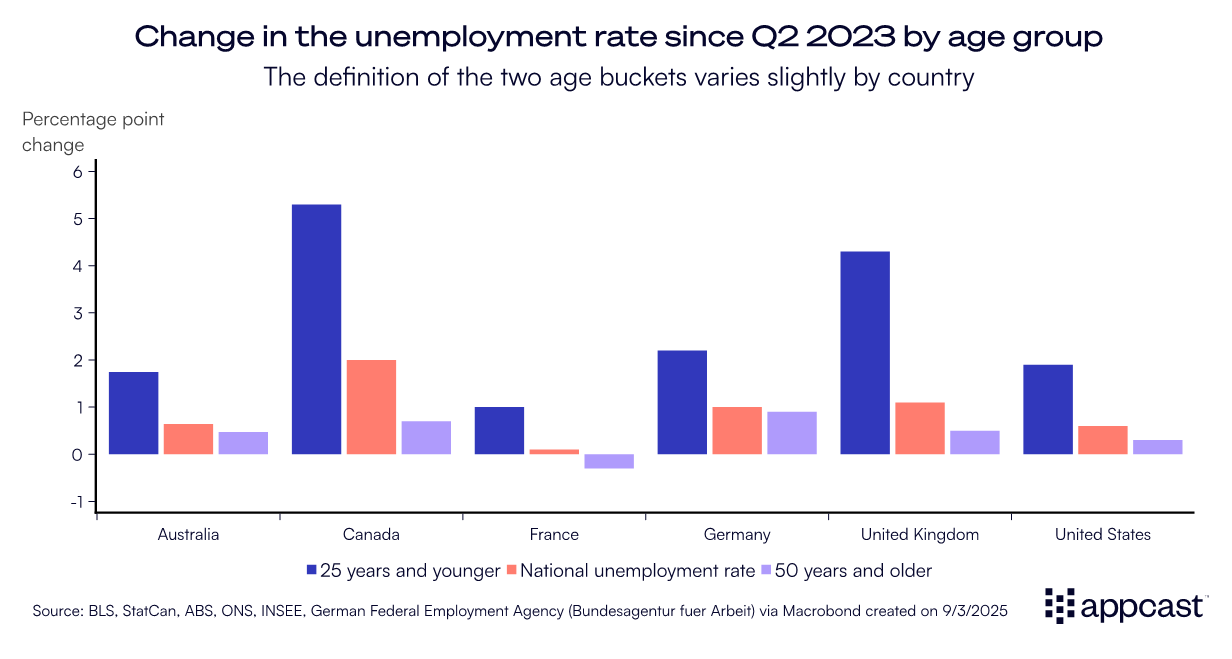
The headline economic data that one typically looks at – unemployment and employment rates – are currently obscuring the pain that younger jobseekers face. While job growth has slowed across advanced economies since 2023, it remains positive across most countries and unemployment rates remain near pre-pandemic lows (Canada is currently the only major economy with unemployment clearly higher than in 2019). Yet these numbers hide a widening divide between different age cohorts.
Young workers are feeling the squeeze
As companies have scaled back hiring, they cut entry-level roles first. That’s why graduate unemployment has jumped several percentage points since 2022 even though overall unemployment has barely shifted. Older workers remain largely insulated for now, with firms continuing to prize experience while freezing junior recruitment in attempt to save on wage costs. This leaves graduates stuck and unable to get a foot on the career ladder in a labor market that has turned static in terms of recruitment.
Short-term pain meets structural change
Two forces drive the Global Graduate Recession: cyclical weakness and long-term shifts.
In the short run, high interest rates and economic uncertainty dominate. Firms are cutting recruitment budgets, delaying projects, and reducing junior hiring across the board. Job postings point to a broad-based slowdown rather than an industry-specific slump.
But structural change is also underway. AI is beginning to hollow out entry-level white-collar roles. Consulting, finance, law, and marketing firms are automating tasks once handled by new hires. Wall Street and big consultancies are already discussing plans to shrink analyst and associate cohorts as workflow automation expands.
While AI’s full labor market impact remains uncertain, it is already altering hiring decisions at the margin. And when the economy rebounds, many of the entry-level roles lost to AI may not return in their old form.
The new reality for graduates
Today’s graduates therefore face a dual challenge: an unusually weak job market and the erosion of traditional entry points into professional careers. The bottom rungs of the ladder are being restructured or removed altogether, turning what once was a temporary downturn into a possible new normal.
What this means for recruiters
For recruiters, the Global Graduate Recession is both crisis and opportunity. With many firms slashing graduate programs, the classic pipeline of large intakes and predictable flows from universities is breaking down.
At the same time, employers are demanding different skills. Adaptability, digital fluency, and the ability to work alongside AI tools are now central to early-career success. Recruiters have a chance to help firms rethink junior roles, identify high-potential candidates for hybrid human-AI workflows, and design sustainable talent strategies.
This isn’t just about short-term hiring freezes. A rapidly aging workforce will eventually create a talent shortage as experienced employees retire. The question is whether companies that neglect young professionals today will find themselves unprepared tomorrow.
Recruiters, then, aren’t just filling roles but shaping the future of work. In a labor market being redefined at its foundations, they are central to ensuring young talent isn’t left behind.